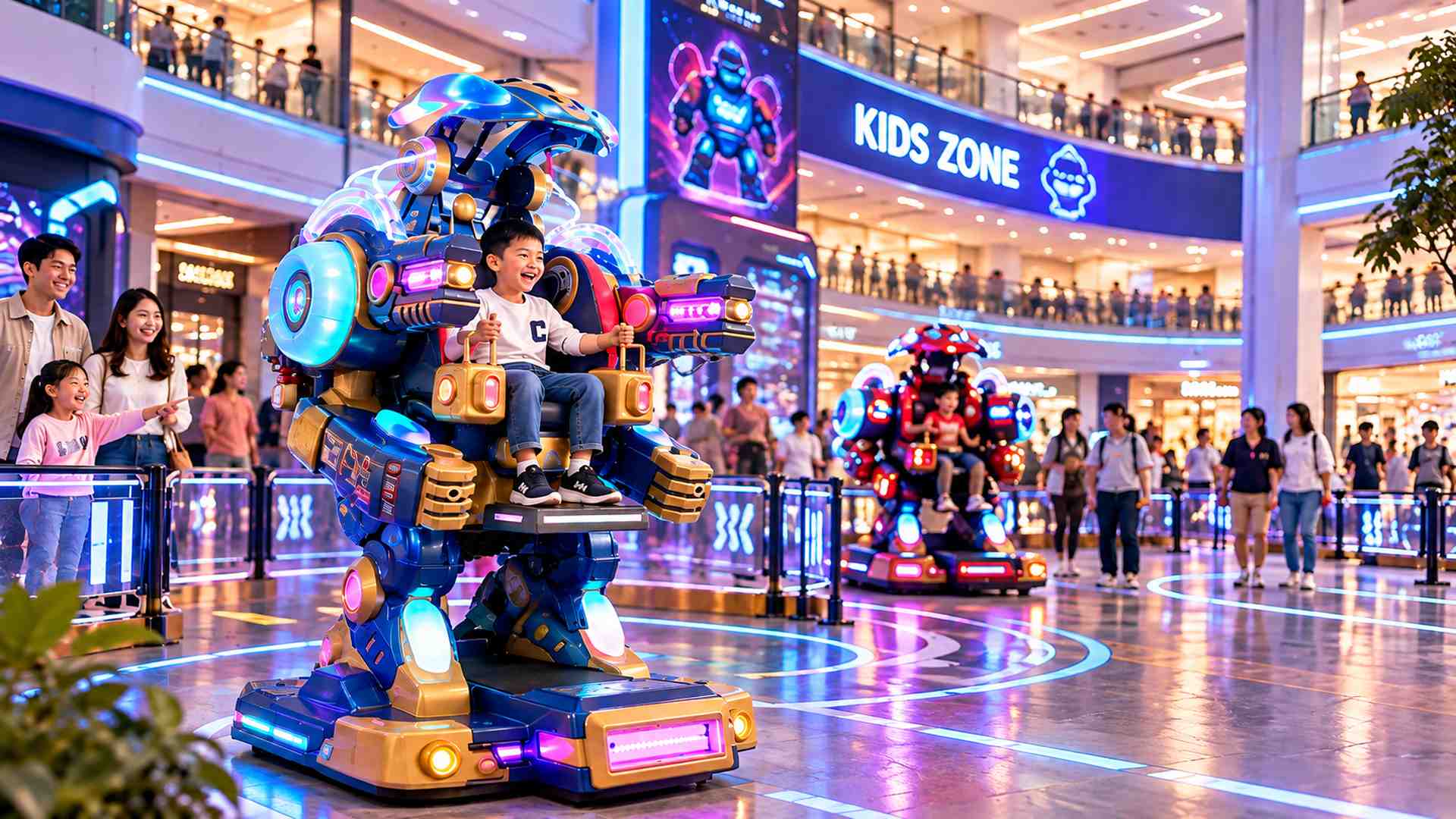
A futuristic robot may attract attention in a shopping mall, but for an amusement business owner, appearance is only the beginning.
Before investing in a commercial walking robot ride, operators need to answer several practical questions.
Will the equipment fit the available space? How many passengers can it accommodate? How long can it operate between charges? What safety features are included? And which model best matches the venue’s target customers?
These questions matter because commercial amusement equipment must do more than look impressive. It must fit into a workable business operation.
Commercial walking robot rides are battery-powered, robot-themed amusement machines designed to carry passengers within designated entertainment areas.
Unlike industrial humanoid robots, HUAQIN’s commercial Walking Robot series moves on motorized wheeled chassis systems rather than walking on mechanical legs.
The robot-inspired exterior creates the visual experience, while the wheeled chassis provides movement.
For shopping mall entertainment operators, family entertainment centers (FECs), amusement parks, and equipment distributors, these attractions offer another category of interactive amusement equipment to consider.
This buying guide compares five HUAQIN robot ride models and explains how to evaluate them for commercial use.
Table of Contents
- 1 Why Consider Walking Robot Rides for Your Amusement Business?
- 2 Understanding How Commercial Walking Robot Rides Move
- 3 Meet HUAQIN’s Five Commercial Walking Robot Models
- 4 Commercial Walking Robot Specifications: Side-by-Side Comparison
- 5 How to Choose the Right Walking Robot for Your Venue
- 6 Planning a Practical Operating Area for Robot Rides
- 7 What Should B2B Buyers Check Before Purchasing?
- 7.1 1. Confirm the Exact Model and Configuration
- 7.2 2. Verify Safety Features
- 7.3 3. Review Passenger Restrictions
- 7.4 4. Understand Battery and Charging Requirements
- 7.5 5. Request Operating and Maintenance Documentation
- 7.6 6. Confirm Warranty and After-Sales Arrangements
- 7.7 7. Verify Shipping and Import Requirements
- 8 Evaluating Operating Costs and Business Potential
- 9 Why Consider Purchasing Directly from HUAQIN?
- 10 Frequently Asked Questions About Buying Walking Robot Rides
- 10.1 What is the best walking robot ride for a shopping mall?
- 10.2 How many passengers can a commercial walking robot carry?
- 10.3 Do walking robot rides use mechanical legs to move?
- 10.4 Which HUAQIN walking robot has the longest specified working time?
- 10.5 Are obstacle-detection systems included?
- 10.6 Can walking robot rides operate outdoors?
- 10.7 How much does a commercial walking robot ride cost?
- 10.8 What information should I provide when requesting a quotation?
- 11 Find the Right Commercial Walking Robot Ride for Your Business
Why Consider Walking Robot Rides for Your Amusement Business?
Traditional kiddie rides, bumper cars, trackless trains, and other mobile amusement machines serve different purposes in commercial entertainment venues.
Walking robot rides introduce another experience: passengers ride within a large robot-themed structure while the equipment moves through a designated operating area.
However, the commercial value of this type of attraction depends on how it fits the venue.
A Distinctive Visual Attraction
Robot-inspired amusement equipment can create a different visual impression from conventional miniature vehicles.
Mechanical body panels, large robot structures, lighting effects, and model-specific interactive features help establish a recognizable attraction theme.
For shopping malls and family entertainment centers, this appearance may provide an opportunity to diversify the existing amusement equipment lineup.
A walking robot ride can also become a visible part of the entertainment environment.
Visitors may notice the equipment while walking through the venue, even if they are not currently participating.
However, visual attention should not be treated as proof of customer demand.
Operators still need to consider local preferences, ticket pricing, visitor demographics, and competition from other attractions.
Interactive Riding Experiences
Some commercial walking robot models include rider-operated controls.
Instead of simply sitting on equipment that follows a fixed movement sequence, passengers can participate in controlling the ride within the permitted operating area.
Depending on the model, additional features may include adjustable speed settings, lighting effects, sound effects, and other interactive functions.
The combination of movement and interaction can help distinguish a robot ride from conventional stationary amusement equipment.
Flexible Equipment Selection
Commercial walking robot rides are available in different dimensions and passenger configurations.
This allows buyers to compare models according to the space and operating requirements of their businesses.
For example, a compact single-rider machine may be worth considering for a venue with limited equipment space.
A larger two-passenger robot ride may be more relevant to operators planning a dedicated robot-themed entertainment area.
The appropriate choice depends on the specific model and venue conditions.
Understanding How Commercial Walking Robot Rides Move
Before comparing models, buyers should understand an important technical characteristic.
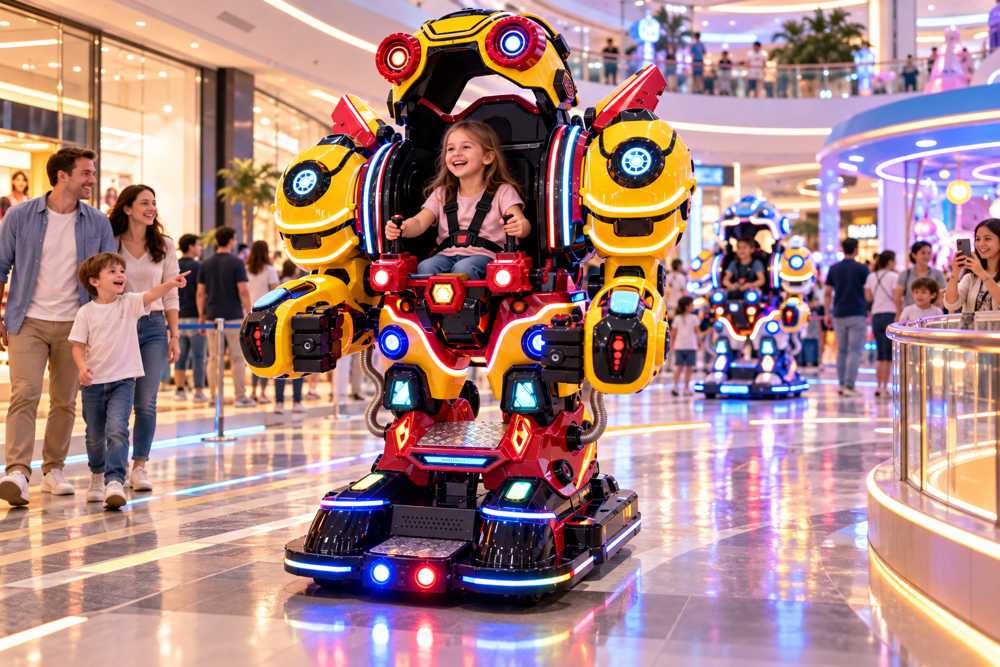
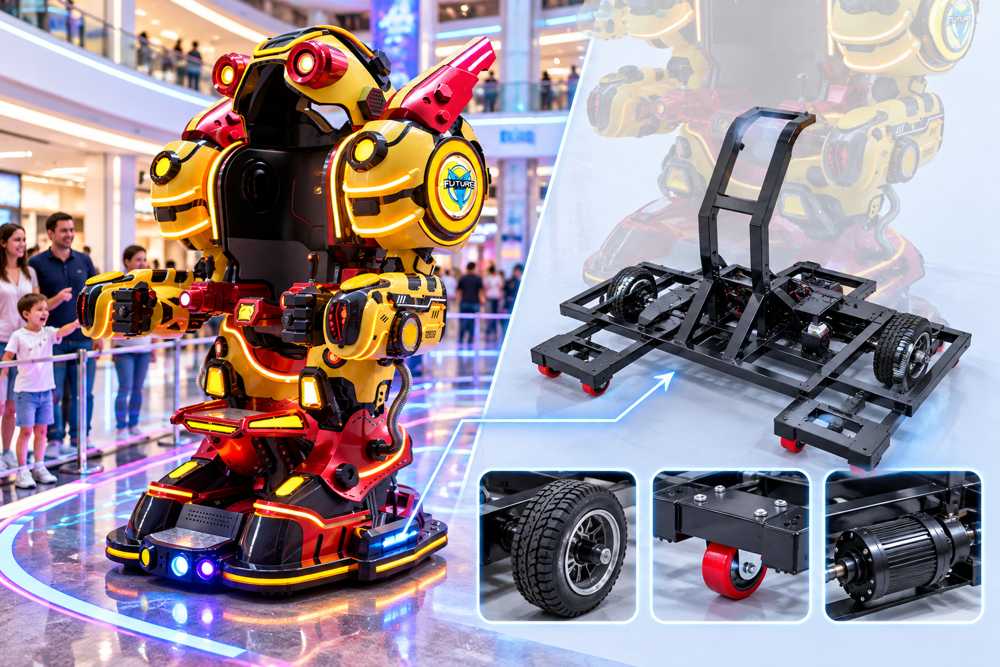
HUAQIN’s five robot amusement ride models all use motorized wheeled chassis systems for movement.
Although the equipment resembles a walking robot, it does not travel by alternately lifting and stepping with mechanical legs.
Instead, the wheeled chassis beneath the robot body provides the actual mobility.
The upper structure creates the robot-inspired appearance and accommodates the passenger area.
This distinction matters when evaluating the equipment’s operation and maintenance.
What Should Buyers Check About the Chassis?
A commercial buyer should ask the manufacturer about:
- Suitable operating surfaces.
- Turning and maneuvering requirements.
- Maximum operating speed.
- Chassis inspection procedures.
- Maintenance requirements.
- Recommended operating boundaries.
These details help determine whether a particular robot ride is appropriate for the intended venue.
A machine’s overall dimensions are not the same as its required operating area.
Additional clearance may be necessary for turning, passenger boarding, pedestrian separation, and staff supervision.
Battery-Powered Mobility
HUAQIN’s Walking Robot series uses onboard batteries to power the equipment.
This allows the rides to move without remaining connected to a fixed electrical outlet during normal operation.
Battery configuration, working time, and charging time vary between models.
Buyers should evaluate these specifications together rather than comparing battery quantity alone.
Operating duration can be affected by passenger load, movement frequency, speed settings, battery condition, and operating conditions.
For commercial businesses, the important question is how the equipment’s charging and working cycles fit the planned operating schedule.
Meet HUAQIN’s Five Commercial Walking Robot Models
HUAQIN manufactures five robot-themed amusement ride models with different dimensions, passenger capacities, speed settings, and interactive features.
Understanding these differences is essential when selecting equipment for a commercial venue.
1. Walking Robot II: A Full-Size Two-Passenger Attraction
Walking Robot II is a full-size robot-themed amusement ride with a height of 240 cm.
Its overall dimensions are 134 × 133 × 240 cm, and its net weight is approximately 250 kg.
The model accommodates a rated capacity of two players, with a maximum load of 115 kg.
Walking Robot II offers three speed settings:
- Low: 2.4 km/h
- Medium: 3.6 km/h
- High: 4.2 km/h
Its specified working time is approximately 5–6 hours, with a charging time of 8–9 hours.
The model is equipped with a radar-based obstacle-detection system.
For amusement operators, Walking Robot II is worth evaluating when looking for a full-size robot ride with adjustable speed settings and interactive passenger controls.
Its dimensions, passenger requirements, and operating characteristics should be assessed against the proposed venue.
2. Aviark Warrior Robot: A Distinctive Robot-Themed Ride
Aviark Warrior Robot measures 165 × 213 × 213 cm and has a net weight of approximately 248 kg.
The model has a rated capacity of two players and a maximum load of 100 kg.
Its specified maximum speed is 3 km/h.
The stated working time is 5–6 hours, followed by an 8–9-hour charging period.
A radar-based obstacle-detection system is included in the supplied specifications.
Compared with Walking Robot II, Aviark Warrior Robot has different overall dimensions and operating speed.
These differences may influence equipment placement, storage requirements, and venue planning.
Operators should review the model’s full technical information before determining whether it fits their business.
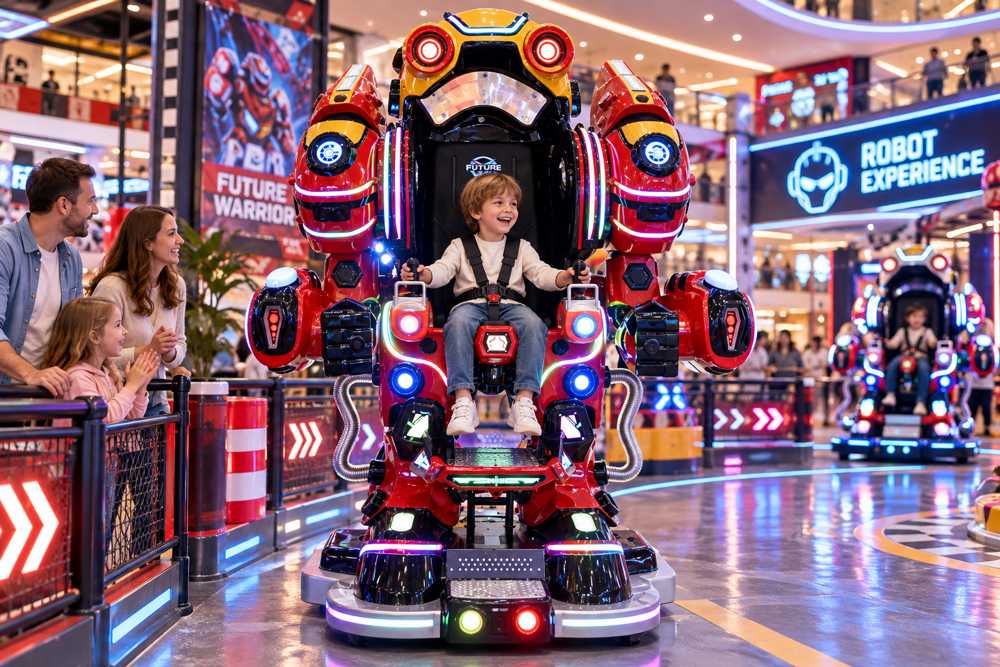
3. Future Warrior: A Robot Ride with a Liftable Cabin Door
Future Warrior is the tallest model in this five-product comparison.
It measures 141 × 183 × 252 cm and has a net weight of 284 kg.
The model has a rated capacity of two players and a maximum load of 100 kg.
Its three speed settings are:
- Low: 3 km/h
- Medium: 3.5 km/h
- High: 4 km/h
Future Warrior has a specified working time of 5–6 hours and a charging time of 8–9 hours.
One of its distinguishing features is a liftable cabin door.
This mechanical feature adds another element to the robot-themed equipment design.
For commercial buyers, the cabin-door mechanism should be evaluated together with the manufacturer’s operating instructions and safety procedures.
The model’s overall height is also an important consideration for indoor venues and transportation planning.
4. Walking Robot I: A Two-Passenger Robot Ride
Walking Robot I measures 163 × 125 × 235 cm and has a net weight of approximately 200 kg.
It has a rated capacity of two players and a maximum load of 115 kg.
Its maximum specified speed is 4.2 km/h.
The model offers three speed settings:
- Low: 2.4 km/h
- Medium: 3.6 km/h
- High: 4.2 km/h
Walking Robot I has a stated working time of approximately four hours and a charging time of 8–10 hours.
It uses two 12V batteries and includes a radar-based obstacle-detection system.
For buyers comparing Walking Robot I and Walking Robot II, battery configuration, working time, dimensions, and rated power are important differences.
These factors should be considered together rather than focusing only on maximum speed.
5. Kiddie Armored Robot: A Compact Single-Rider Model
Kiddie Armored Robot is the smallest machine in HUAQIN’s five-model comparison.
It measures 100 × 67 × 120 cm and has a net weight of approximately 53 kg.
Unlike the other four models, Kiddie Armored Robot has a rated capacity of one player.
Its maximum load is 50 kg.
The model provides three speed settings:
- Low: 2 km/h
- Medium: 2.5 km/h
- High: 3 km/h
Its specified working time is 6–8 hours, with a charging time of 8–10 hours.
An obstacle-detection sensor is available upon request.
Its compact dimensions make Kiddie Armored Robot worth considering when equipment size is an important purchasing factor.
However, buyers should still confirm turning requirements, passenger restrictions, boarding access, and operating boundaries.
Commercial Walking Robot Specifications: Side-by-Side Comparison
The following table summarizes the key technical differences between HUAQIN’s five robot ride models.
| Specification | Walking Robot II | Aviark Warrior Robot | Future Warrior | Walking Robot I | Kiddie Armored Robot |
|---|---|---|---|---|---|
| Dimensions (cm) | 134 × 133 × 240 | 165 × 213 × 213 | 141 × 183 × 252 | 163 × 125 × 235 | 100 × 67 × 120 |
| Battery Configuration | Four 12V batteries | Four 12V batteries | Four 12V batteries | Two 12V batteries | Two 12V batteries |
| Working Time | 5–6 hours | 5–6 hours | 5–6 hours | 4 hours | 6–8 hours |
| Charging Time | 8–9 hours | 8–9 hours | 8–9 hours | 8–10 hours | 8–10 hours |
| Net Weight | 250 kg | 248 kg | 284 kg | 200 kg | 53 kg |
| Maximum Load | 115 kg | 100 kg | 100 kg | 115 kg | 50 kg |
| Rated Players | 2 | 2 | 2 | 2 | 1 |
| Maximum Speed | 4.2 km/h | 3 km/h | 4 km/h | 4.2 km/h | 3 km/h |
| Rated Power | 230 W | 450 W | 450 W | 500 W | 240 W |
| Obstacle Detection | Radar system | Radar system | Radar system | Radar system | Optional sensor |
Specifications are based on HUAQIN’s supplied product information. Battery capacity units are pending technical confirmation. Actual operating time may vary according to usage conditions.
Why Technical Specifications Matter
A commercial robot ride should not be selected based on appearance or maximum speed alone.
For example, Walking Robot I and Walking Robot II both have a maximum specified speed of 4.2 km/h.
However, their battery configurations, working times, net weights, and rated power differ.
Similarly, Kiddie Armored Robot has a longer stated working time than several larger models, but it has a different passenger capacity and equipment size.
These differences illustrate why buyers should compare the complete technical specifications rather than focusing on a single number.
How to Choose the Right Walking Robot for Your Venue
The best commercial walking robot ride depends on the business environment in which it will operate.
Different venues have different space limitations, customer groups, staffing arrangements, and operating schedules.
Shopping Malls: Evaluate Space and Visitor Movement
Shopping malls often have shared pedestrian areas, retail stores, restaurants, and family entertainment zones.
For a mall-based robot ride, operators should evaluate:
- Available floor space.
- Ceiling height.
- Pedestrian circulation.
- Boarding and unloading areas.
- Property management requirements.
- Equipment storage and charging arrangements.
A compact model such as Kiddie Armored Robot may deserve consideration where equipment dimensions are a priority.
Larger models may be evaluated where a dedicated operating area is available.
However, compact dimensions do not automatically guarantee suitability.
The required operating clearance and local venue rules must still be confirmed.
Family Entertainment Centers: Match the Existing Attraction Mix
FEC operators should consider how a walking robot ride fits alongside their existing equipment.
For example, a venue already offering bumper cars, kiddie rides, and arcade games may evaluate whether a robot-themed attraction provides a different customer experience.
Passenger capacity, operating procedures, supervision requirements, and maintenance responsibilities should all be considered.
The selected model should complement the venue’s overall entertainment strategy.
Commercial Plazas: Confirm Outdoor Operating Conditions
Commercial plazas may provide space for mobile amusement attractions.
However, outdoor operation introduces additional considerations.
Buyers should confirm whether the selected model is approved by the manufacturer for the intended outdoor conditions.
Surface quality, weather exposure, pedestrian traffic, and local operating permissions may affect suitability.
A battery-powered design alone does not mean that equipment is suitable for operation in rain or other adverse weather conditions.
Amusement Parks: Consider the Intended Role
An amusement park may evaluate walking robot rides as a supplementary attraction within a broader equipment lineup.
Operators should consider the intended passenger group, operating area, supervision requirements, and maintenance schedule.
A walking robot ride may provide a different type of experience from fixed amusement rides.
However, the commercial value depends on the park’s specific business model and visitor demand.
Planning a Practical Operating Area for Robot Rides
Venue planning is one of the most important steps before purchasing a mobile amusement ride.
Even when the equipment itself fits within the available floor space, additional clearance may be necessary for safe operation.
Establish a Designated Operating Zone
Operators should identify where the equipment will move and how that area will be separated from surrounding pedestrian traffic.
The operating zone should account for the selected model’s movement characteristics and the manufacturer’s instructions.
Allow Space for Boarding and Unloading
Passengers need an appropriate location to enter and exit the equipment.
Operators should consider passenger supervision, boarding procedures, and access requirements.
For models with movable cabin components, such as Future Warrior, the relevant operating procedures should also be reviewed.
Evaluate Floor and Surface Conditions
The operating surface must be suitable for the selected equipment.
Buyers should confirm applicable surface requirements with the manufacturer.
Floor loading, slope, surface condition, and other environmental factors may influence venue suitability.
Plan Charging and Storage
Battery-powered equipment requires suitable charging and storage arrangements.
Operators should identify where the equipment will be charged and how it will be secured when not in use.
Charging procedures should follow the manufacturer’s instructions.
What Should B2B Buyers Check Before Purchasing?
International buyers should evaluate both the equipment and the purchasing process.
A clear purchasing checklist can reduce uncertainty before an order is placed.
1. Confirm the Exact Model and Configuration
Request the current specification sheet for the selected model.
Confirm dimensions, passenger capacity, maximum load, speed settings, working time, and charging requirements.
Do not assume that features available on one model are standard across the entire series.
2. Verify Safety Features
Ask the manufacturer to identify the safety systems included in the quoted configuration.
HUAQIN’s supplied specifications list radar-based obstacle-detection systems for four models.
For Kiddie Armored Robot, an obstacle-detection sensor is available upon request.
Buyers should confirm how these systems function and what operating limitations apply.
Obstacle detection does not replace appropriate supervision or safe operating procedures.
3. Review Passenger Restrictions
Passenger capacity should be considered together with the maximum permitted load and the manufacturer’s passenger requirements.
A two-player rating does not mean that any two passengers can ride together regardless of their combined weight or other restrictions.
4. Understand Battery and Charging Requirements
Confirm the battery configuration, charging time, and recommended operating procedures.
For businesses planning extended daily operation, charging schedules can influence equipment availability.
Buyers should also ask about battery maintenance and replacement requirements.
5. Request Operating and Maintenance Documentation
Commercial amusement equipment requires regular inspection and maintenance.
Buyers should ask for the relevant operating instructions and maintenance guidance.
Clarify which procedures can be performed by trained operators and which require qualified technical personnel.
6. Confirm Warranty and After-Sales Arrangements
Before purchasing, request written information about warranty coverage, technical support, spare parts, and troubleshooting procedures.
For international buyers, remote technical assistance and cooperation with qualified local repair personnel may be particularly relevant.
The exact support arrangements should be confirmed with the manufacturer.
7. Verify Shipping and Import Requirements
International orders require careful coordination of packaging, transportation, and documentation.
Buyers should confirm:
- Packaging method and dimensions.
- Shipping weight.
- Available delivery terms.
- Battery transportation requirements.
- Import documentation.
- Applicable destination-market requirements.
Local regulations and equipment classifications may vary between countries.
Buyers should verify the requirements applicable to their specific destination and intended operation.
Evaluating Operating Costs and Business Potential
A commercial walking robot ride should be evaluated as part of a complete amusement business operation.
The purchase price is only one component of the overall investment.
Other relevant costs may include shipping, import charges, installation, venue rental, staffing, electricity, maintenance, insurance, and replacement parts.
Operators should also consider the expected ticket price, daily operating hours, and realistic customer demand.
A Simple Revenue Planning Example
Consider a hypothetical amusement operator charging $5 per ride.
If the equipment serves 20 paying customers per day, gross daily ticket revenue would be:
$5 × 20 customers = $100 per day
At 26 operating days per month:
$100 × 26 = $2,600 in monthly gross ticket revenue
This example is only an illustration of the calculation.
It is not a forecast of actual customer demand or HUAQIN equipment performance.
Gross ticket revenue does not represent profit.
Operators must subtract all relevant business expenses before evaluating profitability or payback periods.
For two-passenger equipment, capacity planning should also distinguish between the number of ride sessions and the number of paying passengers.
A more useful investment assessment should consider multiple scenarios, including lower-than-expected demand and equipment downtime.
Why Consider Purchasing Directly from HUAQIN?
When sourcing commercial amusement equipment internationally, buyers need reliable product information and clear communication.
Working directly with a manufacturer can provide opportunities to discuss model specifications, available configurations, production requirements, and after-sales arrangements.
HUAQIN manufactures a range of commercial amusement equipment, including its Walking Robot series.
The five models covered in this guide offer different equipment sizes, passenger capacities, operating speeds, and working times.
For amusement operators, importers, and distributors, comparing these differences is an important first step.
Before requesting a quotation, buyers can prepare information about their venue and purchasing requirements.
Useful details include the destination country, intended operating environment, available space, preferred model, target passenger group, and estimated order quantity.
This information can help make technical discussions more specific and productive.
Frequently Asked Questions About Buying Walking Robot Rides
What is the best walking robot ride for a shopping mall?
There is no single model that is best for every shopping mall.
The appropriate choice depends on available space, ceiling height, passenger requirements, operating boundaries, and property management rules.
Buyers should compare model specifications against their venue conditions.
How many passengers can a commercial walking robot carry?
HUAQIN’s Walking Robot I, Walking Robot II, Aviark Warrior Robot, and Future Warrior models have a rated capacity of two players.
Kiddie Armored Robot has a rated capacity of one player.
Maximum load and other passenger restrictions must also be followed.
Do walking robot rides use mechanical legs to move?
HUAQIN’s five commercial robot ride models use motorized wheeled chassis systems.
Their robot-inspired bodies create the visual appearance of mechanical characters, while the wheeled bases provide movement.
Which HUAQIN walking robot has the longest specified working time?
Kiddie Armored Robot has a stated working time of 6–8 hours.
Walking Robot II, Aviark Warrior Robot, and Future Warrior have stated working times of 5–6 hours.
Walking Robot I has a stated working time of four hours.
Actual runtime may vary according to operating conditions.
Are obstacle-detection systems included?
The supplied specifications identify radar-based obstacle-detection systems on Walking Robot I, Walking Robot II, Aviark Warrior Robot, and Future Warrior.
For Kiddie Armored Robot, an obstacle-detection sensor is available upon request.
Buyers should confirm the exact configuration before ordering.
Can walking robot rides operate outdoors?
Outdoor suitability depends on the model and the intended operating conditions.
Buyers should verify the manufacturer’s approved operating environment and any relevant weather or surface restrictions.
How much does a commercial walking robot ride cost?
Pricing depends on the selected model, configuration, order quantity, and purchasing terms.
Buyers should request a quotation based on their specific requirements.
Shipping, import charges, and other costs should also be considered when evaluating the total investment.
What information should I provide when requesting a quotation?
Provide the intended destination, venue type, available operating space, preferred model, estimated quantity, and any required customization.
This helps the manufacturer understand the purchasing requirements and prepare a more relevant response.
Find the Right Commercial Walking Robot Ride for Your Business
Commercial walking robot rides offer amusement operators an opportunity to introduce robot-themed interactive attractions into suitable entertainment venues.
However, choosing the right model requires more than comparing exterior designs.
Equipment dimensions, passenger capacity, working time, charging requirements, safety features, and venue conditions all influence the purchasing decision.
HUAQIN’s five commercial robot ride models provide different configurations for buyers to evaluate.
Whether you operate a shopping mall entertainment area, family entertainment center, amusement park, or commercial plaza, the first step is to identify your actual operating requirements.
Looking for a commercial walking robot ride for your amusement business?
Contact HUAQIN to compare available models, request technical specifications, and discuss equipment options for your venue.
Explore our Walking Robot series or request a quotation from HUAQIN today.